This is a great article by Saulny of the New York Times. Ebony, a reader and friend of mine, passed this on to me and I’d like to pass it along to you. It gives me hope to know that the big crooked letter is more diverse. And it changes perceptions. Check it out for yourself and let’s discuss.
HATTIESBURG, Miss. — For generations here in the deepest South, there had been a great taboo: publicly crossing the color line for love. Less than 45 years ago, marriage between blacks and whites was illegal, and it has been frowned upon for much of the time since.
So when a great job beckoned about an hour’s drive north of the Gulf Coast, Jeffrey Norwood, a black college basketball coach, had reservations. He was in a serious relationship with a woman who was white and Asian.
“You’re thinking about a life in South Mississippi?” his father said in a skeptical voice, recalling days when a black man could face mortal danger just being seen with a woman of another race, regardless of intentions. “Are you sure?”
But on visits to Hattiesburg, the younger Mr. Norwood said he liked what he saw: growing diversity. So he moved, married, and, with his wife, had a baby girl who was counted on the last census as black, white and Asian. Taylor Rae Norwood, 3, is one of thousands of mixed-race children who have made this state home to one of the country’s most rapidly expanding multiracial populations, up 70 percent between 2000 and 2010, according to new data from the Census Bureau.
In the first comprehensive accounting of multiracial Americans since statistics were first collected about them in 2000, reporting from the 2010 census, made public in recent days, shows that the nation’s mixed-race population is growing far more quickly than many demographers had estimated, particularly in the South and parts of the Midwest. That conclusion is based on the bureau’s analysis of 42 states; the data from the remaining eight states will be released this week.
In North Carolina, the mixed-race population doubled. In Georgia, it expanded by more than 80 percent, and by nearly as much in Kentucky and Tennessee. In Indiana, Iowa and South Dakota, the multiracial population increased by about 70 percent.
“Anything over 50 percent is impressive,” said William H. Frey, a sociologist and demographer at the Brookings Institution. “The fact that even states like Mississippi were able to see a large explosion of residents identifying as both black and white tells us something that people would not have predicted 10 or 20 years ago.”
Census officials were expecting a national multiracial growth rate of about 35 percent since 2000, when seven million people — 2.4 percent of the population — chose more than one race. Officials have not yet announced a national growth rate, but it seems sure to be closer to 50 percent.
The contour and the shade of the change are not uniform. In states like California, Hawaii and Oklahoma, where people of mixed race already made up a significant percentage of the total, the increases were smaller than in places like Mississippi, where there were far fewer mixed-race people to start with. In Hawaii, for instance — where the multiracial group accounts for 23 percent of the population, highest of any state — the growth since 2000 was 23.6 percent.
Also, in Hawaii, the predominant mix is Asian and white and native Hawaiian/Pacific Islander, while in Oklahoma, it is American Indian and white. In Mississippi, the most common mix is black and white — historically and today the two groups least likely to intermarry, sociologists say, because of the enduring social and economic distance between them. (It was also against the law until 1967.)
Mississippi led the nation in the growth of mixed marriages for most of the last decade, according to Mr. Frey’s analysis of the American Community Survey. Still, multiracial people are a tiny percentage of the state’s population: 34,000, about 1.1 percent. And many here complain of enduring racial inequities.
There was an uproar last year over comments by Gov. Haley Barbour suggesting that the civil rights era in Mississippi, with its sometimes fatal strife, was not that bad. And some are rankled that the state flag still contains a miniature version of the Confederate battle standard.
Nonetheless, many here also see progress, something akin to “a door opening,” in the words of one resident.
“Racial attitudes are changing,” said Marvin King, a professor of political science at the University of Mississippi who is black, married to a white woman, and the father of a 2-year-old biracial daughter. “Day in, day out, there is certainly not the hostility there was years ago, and I think you see that in that there are more interracial relationships, and people don’t fear those relationships. They don’t have to hide those relationships anymore.”
Mr. Norwood and his wife, Patty Norwood, agreed. “It’s been really smooth here,” said Mr. Norwood, 48, a Hattiesburg resident for 11 years and a men’s basketball coach at William Carey University. He had been most recently coaching at a college in the culturally diverse area of Cajun Louisiana. “I think some people who may not have been comfortable with this in the past have no choice now. I mean, people always told me, the farther south you go, the more racism you’ll feel. But that has not been true.”
Mrs. Norwood, 39, a photographer who is Thai and Chinese on her mother’s side and white on her father’s, added: “I think if people see that you are genuine and in love, and that you are comfortable with yourselves, they are put at ease.”
And unlike in many states, Mississippi’s population has not grown much over the last decade, suggesting to researchers that any change in culture is happening not primarily as a result of newcomers. (Mississippi’s population grew by 3.8 percent since 2000. In contrast, North Carolina’s grew 18.46 percent.)
“North Carolina grew rapidly with Hispanics and blacks and people coming in from out of state and changing things,” Mr. Frey said. “In Mississippi, I think it’s changed from within.”
Changing Identities
The share of the multiracial population under the age of 18 in Mississippi is higher than its share of youth in the general population, suggesting that much of the growth in the mixed-race group can be explained by recent births. But in Mississippi and in other states, some growth may also be a result of older Americans who once identified themselves as black or some other single race expanding the way they think about their identity.
“The reality is that there has been a long history of black and white relationships — they just weren’t public,” said Prof. Matthew Snipp, a demographer in the sociology department at Stanford University. Speaking about the mixed-race offspring of some of those relationships, he added: “People have had an entire decade to think about this since it was first a choice in 2000. Some of these figures are not so much changes as corrections. In a sense, they’re rendering a more accurate portrait of their racial heritage that in the past would have been suppressed.”
Experts say there are some elements, like military service or time spent on a college campus, that lay the groundwork for interracial relationships. With the Camp Shelby military base on its southern side and the University of Southern Mississippi as an anchor, perhaps it is not a surprise that Hattiesburg, a city of about 50,000 residents, and its surrounding counties would show rapid mixed-race growth.
They are also part of Mississippi’s coastal culture, which has historically been more liberal and outward looking — given the port towns — than the rest of the state. (Harrison County, south of Hattiesburg and home to the Gulf Coast cities of Gulfport and Biloxi, has the highest share of mixed-race residents in the state, according to the 2010 census.)
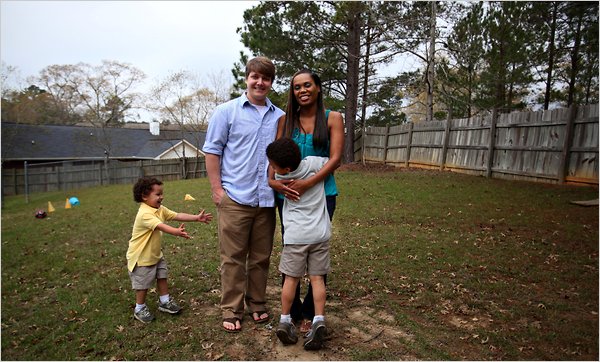
Sonia Cherail Peeples, who is black, met her husband, Michael Peeples, who is white, in the science building at the University of Southern Mississippi in 2003, when they were both students. Friendship ensued, then a crush. “I never dated a black girl before,” Mr. Peeples confided. His family was “old Mississippi,” living mostly around Jackson. At one time, they ran a luggage company.
Sonia Peeples’s ancestors were longtime Mississippians, too, but they were sharecropping cotton.
The differences in the past did not matter in the present, they both agreed.
“I really never thought twice about it,” Mrs. Peeples, 29, said of dating Michael, 30. “Everyone was open to it and I thought: ‘He has potential. I could marry this guy!’ ”
And she did. Now they have two boys: Riley, 3, and Gannon, 5, who Mrs. Peeples likes to say are “black, white and just right!”
“It’s a generational thing,” Mr. Peeples added, noting that his mother has been hot and cold about the relationship over the years, accepting his new family, then sometimes pulling away for a while, only to return, drawn by her grandsons. “I think many older people are set in their ways, but 40 years old or younger, you’ll never get the sense that something’s wrong,” he said.
After college, the couple moved to Denver, but eventually decided to return to Hattiesburg, where Mr. Peeples works at a local dairy.
“I told the Realtor, ‘Don’t put us in a predominantly white or black neighborhood,’ ” Mrs. Peeples recalled. “And sure enough, we have a biracial kid next door.”
According to the census, multiracial people are more likely to live in neighborhoods that have a broad mix of races with a higher share of whites than those who identify as black alone. This suggests they enjoy higher socioeconomic status, Mr. Frey, the demographer, said.
Lingering Tensions
Still, for the Peeples family, there have been some testy moments. There was the time when another parent at Gannon’s school asked if his terrible allergies had something to do with “race mixing.” And there was the hospital worker who treated Mrs. Peeples as though she was trying to snatch a white baby when she took Riley, who had blond curls, out of his crib in the nursery. “This is my baby! He just looks like his dad,” Mrs. Peeples, who has deep brown skin, remembered scolding the woman.
But both Sonia and Michael Peeples are mindful that those few incidents are insignificant in comparison to what previous generations endured.
“I would not have wanted to live in my parents’ or grandparents’ time,” said Mrs. Peeples, a full-time homemaker. “We’re teaching our kids all of it, all their history. My 5-year-old asks, ‘People who looked like you, why did they treat them so bad?’ It’s hard to explain to a biracial child in 2011. In a perfect world, race wouldn’t matter, but that day’s a while off.”
The Norwoods have also experienced minor tensions. A waitress at a restaurant might abruptly decide that she cannot serve their table. Even when they are locked arm in arm, someone might ask incredulously, “Are you together?” Clerks at the supermarket want to ring up their groceries separately.
But there is one place where they know that old thinking patterns are being challenged: at their church.
The Rev. Dr. Martin Luther King Jr. called Sunday morning church service the most segregated hour in America, but one would not know that at Grace Temple Ministries, the neighborhood church where the Norwoods worship and socialize with other mixed-race families. The pastor is white and the assistant pastor is black, and the creative arts pastor is Latino. During a recent sermon, the congregation’s guiding ethos on social issues was clear: “Let us not be guilty of thinking as the culture and society decides,” said the pastor, Dwayne Higgason.
Unlike the Peepleses, Jeffrey and Patty Norwood did not seek a diverse neighborhood, but found themselves in one anyway. In 2001, they bought the first home built on a developing street before any neighbors had even purchased lots. As houses sprang up, their neighbors turned out to be black families, white families and mixes of the two.
“Between our church and the neighborhood, this is the most diverse place I’ve been,” said Mr. Norwood, a native of Tupelo, Miss. “I’ve never experienced anything quite like this.”
Growing up in Victoria, Tex., Mrs. Norwood said she was never quite sure what race to mark on forms, and she hardly ever saw people like herself
“I usually went with Asian because I could only check one box,” Mrs. Norwood said. “Our daughter’s life will not be like that. She knows what she is and she’s exposed to a little bit of everything. The times have certainly changed.”

 Writing gives me pleasure for several reasons. I love to entertain people and take them from the real world into some new place with new people, and I love to meet new people through my books. The readers, reviewers, publishers, conventioneers, etc. are all amazing. Normally, I get the reviews later than everyone else, because I’m always in my office or in my “room” at home behind a desk, typing on the computer, music blasting in my ears, television playing – away from the world and everyone around it. However, lately, I’ve been getting out. So, I’ve been getting the reviews as they post, and I have quite enjoyed it.


 Author Latrivia Welch Official Blog